> For the complete documentation index, see [llms.txt](https://docs.mapsindoors.com/llms.txt). Markdown versions of documentation pages are available by appending `.md` to page URLs; this page is available as [Markdown](https://docs.mapsindoors.com/sdks-and-frameworks/web/map-visualization/change-building-outline-color.md).
# Change Building Outline
## Crafting a Dynamic, Color-Transitioning Example
Here's a code snippet that alternates the building outline color every second, cycling through a palette of contrasting colors, it's not the most practical application, but it shows how to achieve it.
You may desire a way to change the stroke color based on user requirements to make the map meet different accessibility requirements.
Changing border color programmatically
```javascript
const colors = ['#E63946', '#F1FA8C', '#A8DADC', '#457B9D'];
// Initialize an index to keep track of the current color
let colorIndex = 0;
// Use setInterval to create a loop that runs every 1000 milliseconds (1 second)
setInterval(() => {
// Set the building outline color to the current color
mapsIndoorsInstance.setBuildingOutlineOptions({strokeColor: colors[colorIndex]});
// Increment the color index, cycling back to 0 if we've reached the end of the colors array
colorIndex = (colorIndex + 1) % colors.length;
}, 1000);
```
### Additional Details
To change the building outline color use the [`strokeColor`](https://developer.mozilla.org/en-US/docs/Web/CSS/color_value) property of the [`BuildingOutlineOptions` interface](https://app.mapsindoors.com/mapsindoors/js/sdk/latest/docs/BuildingOutlineOptions.html). This property accepts any color as defined by conventional CSS color values.
See for more information on CSS color values.
To do this in practice, on the MapsIndoors instance, call `setBuildingOutlineOptions` to change the appearance of the building outline.
```javascript
mapsIndoors.setBuildingOutlineOptions({strokeColor: '#3071d9'});
```
## CMS configuration
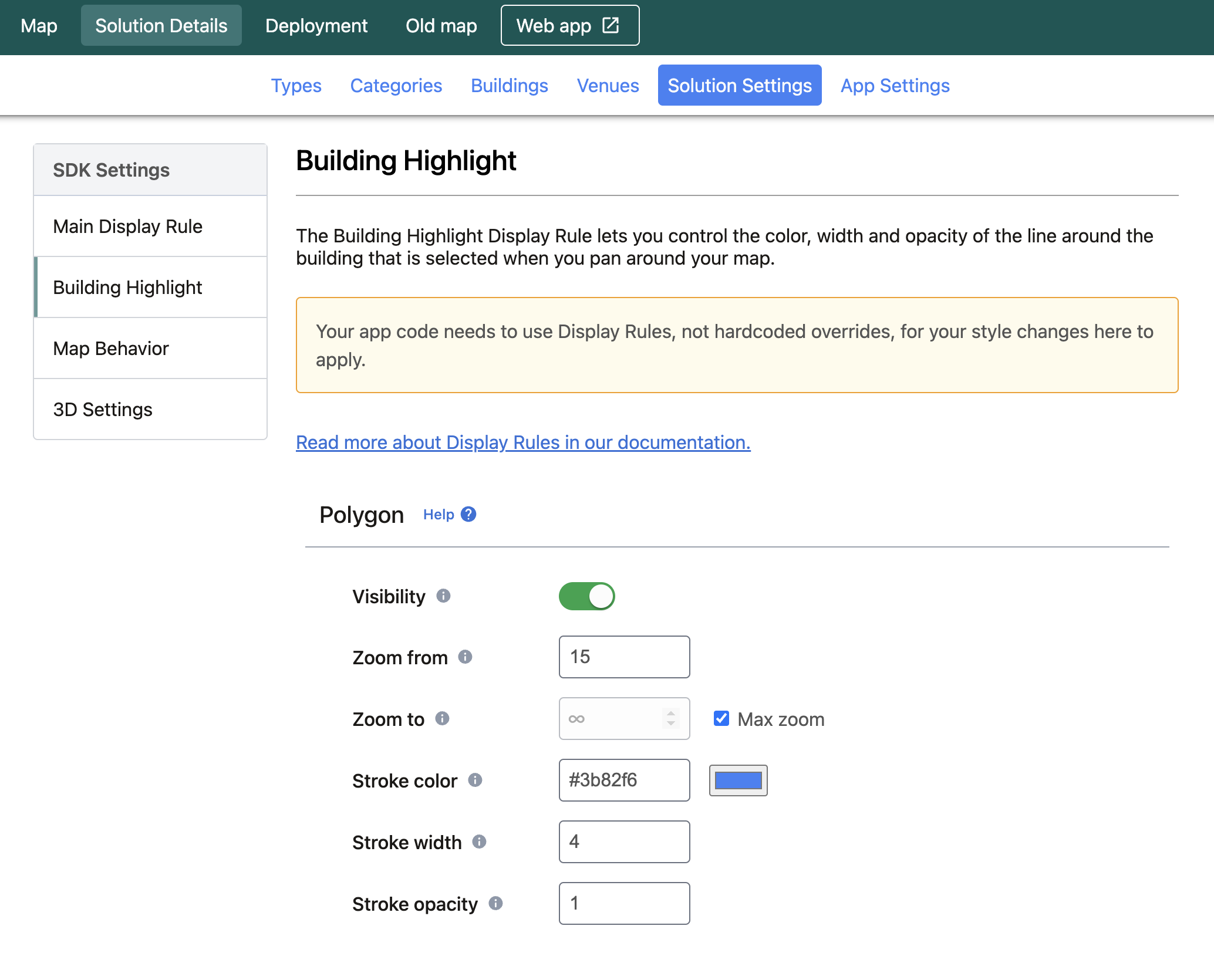
The building outline design will be taken from the values set through the CMS.
### Overriding the CMS configuration via the SDK
To change the building outline you can use the different properties of the `BuildingOutlineOptions` interface. The properties are the following:
1. `visible` - Controls whether the Building Outline is visible on the map.
* The value should be a Boolean here, so either `true` or `false`.
2. `zoomFrom` - Sets the minimum Zoom Level at which the Building Outline is visible.
* The value should be a number between 1 and 25, with 1 being very far away, and 25 being very close (25 not available for all Solutions). In a general use case, most users will only need values between 15 and 25.
3. `zoomTo`- Sets the maximum Zoom Level at which the Building Outline is visible.
* The value should be a number between 1 and 25, with 1 being very far away, and 25 being very close (25 not available for all Solutions). In a general use case, most users will only need values between 15 and 25.
4. `strokeColor` - Controls the stroke color of the Building Outline.
* This property accepts any color as defined by conventional CSS color values. See for more information on CSS color values.
5. `strokeWeight` - Controls the stroke width (in pixels) of the Building Outline.
* The value should be a number between.
6. `strokeOpacity` - Controls the stroke opacity of the Building Outline.
* The value should be a number between 0 and 1, for example a value of 1 gives 100% opacity, 0.2 gives 20% opacity, etc.
To read more about the `BuildingOutlineOptions` interface see the [reference docs](https://app.mapsindoors.com/mapsindoors/js/sdk/latest/docs/BuildingOutlineOptions.html).
One way to do this in practice, call `setBuildingOutlineOptions` on the MapsIndoors instance, to change the appearance of the building outline.
```javascript
mapsIndoorsInstance.setBuildingOutlineOptions({
visible: true,
zoomFrom: 15,
zoomTo: 20,
strokeColor: '#fcd305',
strokeWeight: 5,
strokeOpacity: 0.8
});
```
Alternatively, you can define the `buildingOutlineOptions` property when creating a new mapsindoors instance.
```javascript
new mapsindoors.MapsIndoors({
mapView: mapView,
buildingOutlineOptions: {
visible: true,
zoomFrom: 15,
zoomTo: 20,
strokeColor: '#fcd305',
strokeWeight: 5,
strokeOpacity: 0.8
}
});
```
[ ](https://docs.mapsindoors.com/display-language)
---
# Agent Instructions
This documentation is published with GitBook. GitBook is the documentation platform designed so that both humans and AI agents can read, navigate, and reason over technical content effectively. Learn more at gitbook.com.
## Querying This Documentation
If you need additional information that is not directly available in this page, you can query the documentation by asking a question.
Perform an HTTP GET request on the following URL with the `ask` and `goal` query parameters:
```
GET https://docs.mapsindoors.com/sdks-and-frameworks/web/map-visualization/change-building-outline-color.md?ask=&goal=
```
`ask` is the immediate question: it should be specific, self-contained, and written in natural language.
`goal` is what the user is ultimately trying to achieve, the reason they need the answer. Sharing it helps GitBook give you a better, more relevant answer. A goal is most helpful when it describes the outcome the user wants rather than restating the question. For example, with `ask=how do I create an API token`, a goal like `automate deployments from our CI pipeline` lets GitBook tailor the answer to that use case.
The response will contain a direct answer to the question and relevant excerpts and sources from the documentation.
Use this mechanism when the answer is not explicitly present in the current page, you need clarification or additional context, or you want to retrieve related documentation sections.