> For the complete documentation index, see [llms.txt](https://docs.mapsindoors.com/llms.txt). Markdown versions of documentation pages are available by appending `.md` to page URLs; this page is available as [Markdown](https://docs.mapsindoors.com/sdks-and-frameworks/web/map-visualization/remove-labels-from-buildings-and-venues.md).
# Remove Labels from Buildings and Venues
**Are your building and venue labels disrupting your user experience?**
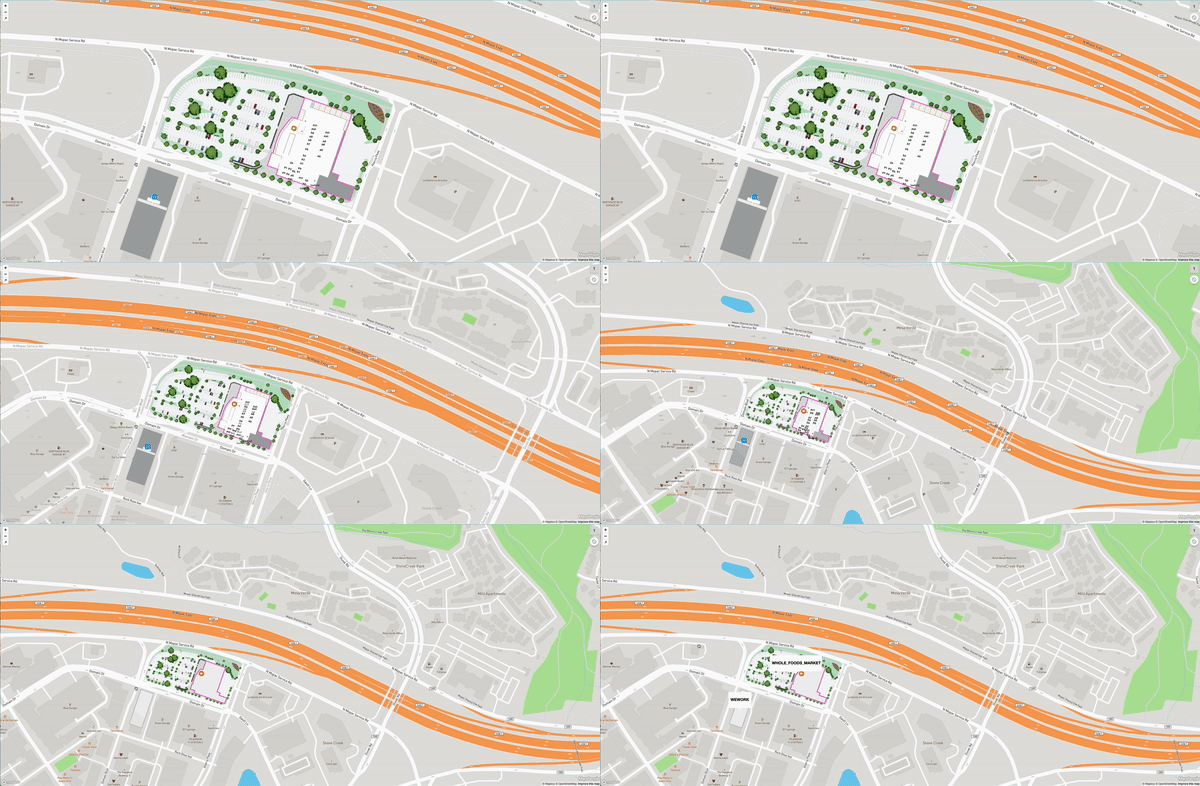
Traditionally, both Buildings and Venues are treated as Locations in the Web SDK, inherently displaying Labels which might not always align with the desired user experience. A conventional method to manage their visibility is illustrated below via a [**`setDisplayRule`**](https://app.mapsindoors.com/mapsindoors/js/sdk/latest/docs/mapsindoors.MapsIndoors.html#setDisplayRule)
It can be a best practice to set this display rule after initializing your MapsIndoors instance.
```javascript
mapsIndoorsInstance.setDisplayRule(['MI_BUILDING', 'MI_VENUE'], { visible: false });
```
Here, `MI_BUILDING` and `MI_VENUE` are specific Location Types dedicated to facilitate display rule settings for Buildings and Venues respectively.
**Enhancing User Interaction with Adaptive Zoom-Level Popups**
Dynamically adding a Mapbox Popup based on zoom level
Let's say a user zooms out to get a broad overview of a large campus or city area. At a lower zoom level, the display becomes less cluttered, paving the way for a more clear, bird's eye view of the venues available. Here’s where dynamic, zoom-dependent [**popups**](https://docs.mapbox.com/mapbox-gl-js/example/popup/) come into play, serving as intuitive markers and information windows. This example is specific to Mapbox, for Google Maps you will need to use [**info windows**](https://developers.google.com/maps/documentation/javascript/infowindows).
Integrating the following code snippet enables the application to listen for changes in zoom level, and depending on the zoom threshold, dynamically fetch venues and exhibit crisp, stylish popups at each venue’s anchor point:
```javascript
let popups = [];
mapsIndoorsInstance.addListener('zoom_changed', (zoomLevel) => {
if (zoomLevel < 19) {
mapsindoors.services.VenuesService.getVenues().then(venues => {
venues.forEach(venue => {
const anchor = venue.anchor.coordinates;
const popup = new mapboxgl.Popup({ closeOnClick: true, closeButton: false, className: 'custom-popup' })
.setLngLat([anchor[0], anchor[1]])
.setHTML(`
${venue.name}
`)
.addTo(mapsIndoorsInstance.getMap());
popups.push(popup);
});
});
} else {
popups.forEach(popup => popup.remove());
popups = [];
}
});
```
**What does this achieve?**
When the map zoom level is below 19, unobtrusive popups appear, providing users with a quick overview of each venue’s name. Upon zooming in beyond the level 19, the popups discreetly vanish, preventing any visual obstruction and facilitating an unhindered exploration of the MapsIndoors map.
---
# Agent Instructions
This documentation is published with GitBook. GitBook is the documentation platform designed so that both humans and AI agents can read, navigate, and reason over technical content effectively. Learn more at gitbook.com.
## Querying This Documentation
If you need additional information that is not directly available in this page, you can query the documentation by asking a question.
Perform an HTTP GET request on the following URL with the `ask` and `goal` query parameters:
```
GET https://docs.mapsindoors.com/sdks-and-frameworks/web/map-visualization/remove-labels-from-buildings-and-venues.md?ask=&goal=
```
`ask` is the immediate question: it should be specific, self-contained, and written in natural language.
`goal` is what the user is ultimately trying to achieve, the reason they need the answer. Sharing it helps GitBook give you a better, more relevant answer. A goal is most helpful when it describes the outcome the user wants rather than restating the question. For example, with `ask=how do I create an API token`, a goal like `automate deployments from our CI pipeline` lets GitBook tailor the answer to that use case.
The response will contain a direct answer to the question and relevant excerpts and sources from the documentation.
Use this mechanism when the answer is not explicitly present in the current page, you need clarification or additional context, or you want to retrieve related documentation sections.